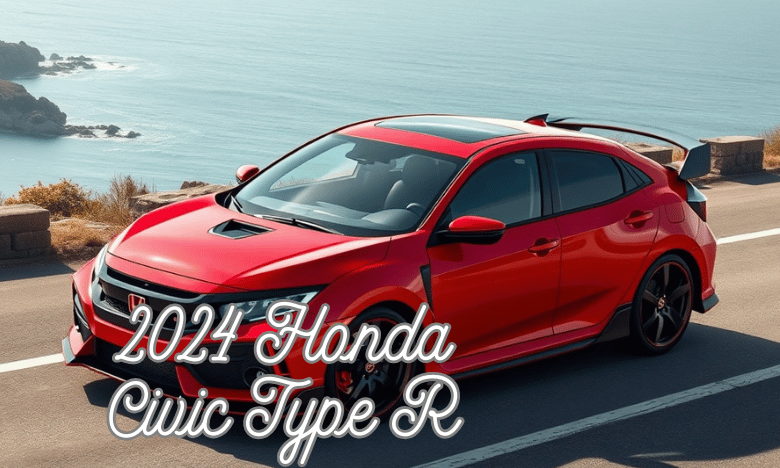
The 2024 Honda Civic Type R is the second model year of the FL5 generation, and it remains one of the most complete performance hatchbacks ever built — a 315-horsepower, front-wheel-drive car with a six-speed manual, a helical limited-slip differential and Michelin Pilot Sport 4S tires as standard, yet one that still returns 24 mpg combined and swallows 24.5 cubic feet of cargo.
This guide covers the 2024 Civic Type R in full: verified engine and performance specifications, real acceleration and top speed figures, exact MSRP and destination charge, curb weight and dimensions, chassis and brake hardware, interior and technology, and how the 2024 car compares with the newer model years now that it has become a used-market proposition.
2024 Honda Civic Type R at a Glance
| Category | Specification |
|---|---|
| Model | 2024 Honda Civic Type R (FL5) |
| Engine | 2.0-liter turbocharged DOHC VTEC inline-four, 1,996cc |
| Horsepower | 315 hp @ 6,500 rpm (SAE net) |
| Torque | 310 lb-ft @ 2,600–4,000 rpm (SAE net) |
| Compression / boost | 9.8:1 / 25.2 psi |
| Transmission | 6-speed manual with Rev-Match Control |
| Differential | Helical limited-slip |
| 0–60 mph | Approximately 5.0 seconds (tested) |
| Top speed | Approximately 171 mph (275 km/h) |
| Curb weight | 3,188 lbs (1,446 kg) |
| Length x Width x Height | 180.9 in x 74.4 in x 55.4 in |
| Wheelbase | 107.7 in |
| Ground clearance | 4.8 in |
| Wheels and tires | 19 x 9.5J matte black; Michelin Pilot Sport 4S 265/30ZR19 |
| Front brakes | Brembo 4-piston aluminum calipers, ventilated discs |
| Suspension | Dual-axis MacPherson strut front, multi-link rear, adaptive dampers |
| EPA fuel economy | 22 city / 28 highway / 24 combined mpg |
| Fuel tank | 12.4 gallons (premium recommended) |
| Seating / cargo | 4 passengers / 24.5 cu ft |
| Infotainment | 9-inch touchscreen, wireless Apple CarPlay and Android Auto |
| Drive modes | Comfort, Sport, +R, Individual |
| MSRP | $44,795 (plus $1,095 destination = $45,890) |
Engine and Powertrain
The 2024 Civic Type R is powered by Honda’s K20C1 — a 1,996cc turbocharged DOHC inline-four with VTEC on the exhaust side, direct injection and an air-to-air intercooler. It runs a 9.8:1 compression ratio with up to 25.2 psi of boost, and it produces 315 horsepower at 6,500 rpm and 310 lb-ft of torque from 2,600 to 4,000 rpm.
Those numbers matter less than how the engine delivers them. Peak torque arrives just above 2,600 rpm and holds flat to 4,000 rpm, so the car pulls hard from low revs without the abruptness of a peaky turbo motor. The FL5’s redesigned intake, larger grille opening and revised turbocharger improve throttle response over the previous FK8 generation, and the exhaust system’s three-pipe layout keeps the mid-range note clean rather than droning at highway speed.
Honda specifies regular unleaded as acceptable but recommends premium fuel. On a 12.4-gallon tank and the EPA’s 24 mpg combined rating, the realistic touring range is close to 290–300 miles.
Transmission, Differential and Handling Hardware
The Type R is sold with one gearbox only: a six-speed manual with a lightweight single-mass flywheel, a short-throw aluminum shifter and Rev-Match Control that blips the throttle on downshifts. It can be switched off if you prefer to heel-and-toe yourself. Enthusiasts who value a proper manual transmission consistently rate this as one of the best shifters fitted to any modern production car.
Traction comes from a helical limited-slip differential, and the front suspension uses a dual-axis MacPherson strut design that separates steering and damping loads to cut torque steer — the single biggest reason a 315-horsepower front-wheel-drive car can put its power down cleanly. The rear is multi-link, and adaptive dampers adjust in real time based on the selected drive mode.
Braking is handled by Brembo four-piston aluminum calipers on ventilated front discs with solid rear discs, and grip comes from Michelin Pilot Sport 4S tires in 265/30ZR19 on 19 x 9.5J matte black alloy wheels. This is genuine track hardware fitted as standard equipment, not an optional package.
Top Speed and Acceleration
- 0–60 mph: approximately 5.0 seconds in instrumented testing
- 0–100 km/h: approximately 5.4 seconds
- Quarter mile: around 13.5 seconds
- Top speed: approximately 171 mph (275 km/h)
A five-second 0–60 time does not sound extraordinary in a world of quick electric crossovers, but it undersells the car badly. The Type R’s strength is the way it carries speed: it gains time in corners, under braking and on corner exit rather than in a straight line. Its lap times consistently embarrass cars with far bigger power figures, and Honda’s own testing has the FL5 as the quickest front-wheel-drive car it has produced.
MSRP and Pricing
| Item | Detail |
|---|---|
| Base MSRP | $44,795 |
| Destination charge | $1,095 |
| Total as delivered | $45,890 |
| Trim levels | Single fully-loaded trim; no factory options |
| Segment | High-performance compact hatchback |
| Main rivals | Volkswagen Golf R, Toyota GR Corolla, Hyundai Elantra N, Subaru WRX |
The 2024 car carried a $1,900 increase over the 2023 model. Prices have kept climbing since: the 2026 Civic Type R starts at $46,895, or $48,090 with destination — roughly $2,200 more than the 2024 car for a mechanically near-identical vehicle. That is the strongest argument for buying a 2024 example today.
Note that dealer markups over MSRP were common on early FL5 cars, so the price a 2024 Type R actually sold for was frequently higher than the sticker. On the used market that premium has largely evaporated, which makes a clean, unmodified 2024 car one of the better value propositions in performance hatchbacks.
Weight and Dimensions
- Curb weight: 3,188 lbs (1,446 kg)
- Length: 180.9 inches
- Width: 74.4 inches
- Height: 55.4 inches
- Wheelbase: 107.7 inches
- Ground clearance: 4.8 inches
- Cargo volume: 24.5 cubic feet
At roughly 3,190 lbs the Type R is light by modern standards — a Volkswagen Golf R carries around 300 lbs more, and most performance EVs are 1,000 lbs heavier. Combined with a wide 74.4-inch track and a low center of gravity, that low mass is why the car changes direction so willingly and why its brakes resist fade so well on track.
The 4.8-inch ground clearance is the practical downside. Steep driveways and speed bumps require care, and the front splitter is a genuine consideration if you live somewhere with aggressive road furniture.
Exterior Design and Aerodynamics
Styling
The FL5 is a substantially more restrained design than the FK8 it replaced. Honda removed the fake vents and stacked surfacing of the previous car in favor of a wider, flatter stance, a longer wheelbase and cleaner body sides. It still reads unmistakably as a Type R thanks to the triple exhaust outlets, red badging and functional rear wing, but it is a car you can park outside an office without embarrassment.
Functional Aerodynamics
Every major exterior element earns its place. The larger grille opening feeds the intercooler and radiator, the front air curtains manage turbulence around the wheel arches, the flat underbody reduces lift, and the rear wing generates real downforce rather than decoration. Honda’s aerodynamic work on the FL5 focused on high-speed stability, which is what allows the car to feel planted at track speeds rather than merely fast in a straight line.
Wheels and Tires
The 19 x 9.5J matte black wheels are lighter than the FK8’s 20-inch items, which reduces unsprung mass and improves ride quality. They are wrapped in Michelin Pilot Sport 4S rubber in 265/30ZR19 — a tire that costs real money to replace but delivers the mechanical grip the chassis is tuned around. Fitting cheaper tires is the fastest way to undo what makes this car special.
Interior, Technology and Comfort
The Type R’s cabin is the standard eleventh-generation Civic interior — praised for its honest layout, physical climate controls and metal mesh dashboard trim — reworked for performance driving:
- Deeply bolstered red suede-effect sport seats with a low seating position
- Aluminum shift knob, alloy pedals and red carpeting
- Digital driver’s display that reconfigures per drive mode, including a +R layout with a shift-light bar
- 9-inch touchscreen with wireless Apple CarPlay and Android Auto
- Bose premium audio system
- Honda LogR performance data logger for lap times and telemetry
- Four-passenger seating with 24.5 cubic feet of cargo space behind the rear seats
The four drive modes — Comfort, Sport, +R and Individual — adjust damper firmness, steering weight, throttle mapping, rev-match aggression and engine sound. Comfort is genuinely comfortable, which is what makes the Type R usable as a daily driver in a way most track-focused cars are not. Individual mode lets you combine, for example, +R powertrain settings with Comfort damping for rough public roads.
Safety and Driver Assistance
- Honda Sensing suite including adaptive cruise control, collision mitigation braking, lane keeping assist and road departure mitigation
- Vehicle stability assist with traction control
- Multi-angle rearview camera
- Advanced front, side and side-curtain airbags
- Anti-lock braking with electronic brake distribution and brake assist
Because the Type R is sold in a single fully-equipped trim, none of this is optional — every car has the full driver-assistance package.
Is the 2024 Civic Type R a Good Buy Now?
Mechanically, the 2024 FL5 is essentially the same car Honda still sells today: the same engine output, the same gearbox, the same chassis and the same brakes. The differences between model years are limited to colors, minor equipment and price. Buying a 2024 example rather than a new one saves several thousand dollars for a car that drives identically.
What to check before buying one:
- Track history — many were used as intended. Ask about brake fluid changes, pad and rotor condition and any oil cooling upgrades.
- Tires — a set of Pilot Sport 4S is a meaningful expense; check tread depth and confirm the original specification is fitted.
- Front-end damage — the low splitter is easily scraped, and a repainted bumper can hide worse.
- Modifications — tuned cars can void warranty coverage; an unmodified example is worth paying more for.
- Service history — Honda’s maintenance minder schedule should have been followed to the letter on a turbocharged engine.
Conclusion
The 2024 Honda Civic Type R is the rare performance car with no meaningful compromise. It produces 315 horsepower from a turbocharged 2.0-liter engine, reaches 60 mph in around five seconds, tops out near 171 mph, weighs just 3,188 lbs and still returns 24 mpg combined while seating four and carrying 24.5 cubic feet of luggage. The six-speed manual, helical limited-slip differential, adaptive dampers, Brembo brakes and Michelin Pilot Sport 4S tires are all standard.
With the current model now approaching $48,000 as delivered, a well-kept 2024 car at a used price is one of the smartest ways into a modern driver’s car — and, as manual transmissions disappear from the market, one that is likely to be remembered as a high point of the hot-hatch era.
Looking for more from our garage? Read our breakdown of the 2022 Silverado: performance, power and practicality in one package, browse the rest of our EVs and Automobile category, or take a look at our guide to the best walking pad in 2026 if you are kitting out the home side of your setup too.
Frequently Asked Questions
How much does a 2024 Honda Civic Type R cost?
The 2024 Civic Type R carried a base MSRP of $44,795, or $45,890 including the $1,095 destination charge. It was sold in a single fully-equipped trim with no factory options. For comparison, the 2026 model starts at $46,895 before destination.
How much horsepower does the 2024 Civic Type R have?
315 horsepower at 6,500 rpm and 310 lb-ft of torque from 2,600 to 4,000 rpm, from a 2.0-liter turbocharged VTEC inline-four.
What is the 0–60 mph time of the 2024 Civic Type R?
Approximately 5.0 seconds in instrumented testing, with a quarter mile in the low 13-second range. Its real advantage over rivals shows in cornering speed and braking rather than straight-line acceleration.
What is the top speed of the 2024 Honda Civic Type R?
Approximately 171 mph (275 km/h).
Does the 2024 Civic Type R come with an automatic transmission?
No. The Type R is sold exclusively with a six-speed manual gearbox featuring Rev-Match Control, a lightweight flywheel and a helical limited-slip differential.
How much does the 2024 Civic Type R weigh?
3,188 lbs (1,446 kg) at the curb — roughly 300 lbs lighter than an all-wheel-drive Volkswagen Golf R, which is central to how it handles.
What is the difference between the Civic Si and the Civic Type R?
They are separate cars rather than trim levels. The Si uses a 1.5-liter turbocharged engine producing around 200 horsepower, while the Type R uses a 2.0-liter turbo with 315 horsepower plus a helical limited-slip differential, adaptive dampers, Brembo brakes, wider tires and unique bodywork. The Type R costs considerably more.
What fuel economy does the 2024 Civic Type R get?
The EPA rates it at 22 mpg city, 28 mpg highway and 24 mpg combined. Honda specifies regular unleaded as acceptable but recommends premium fuel.