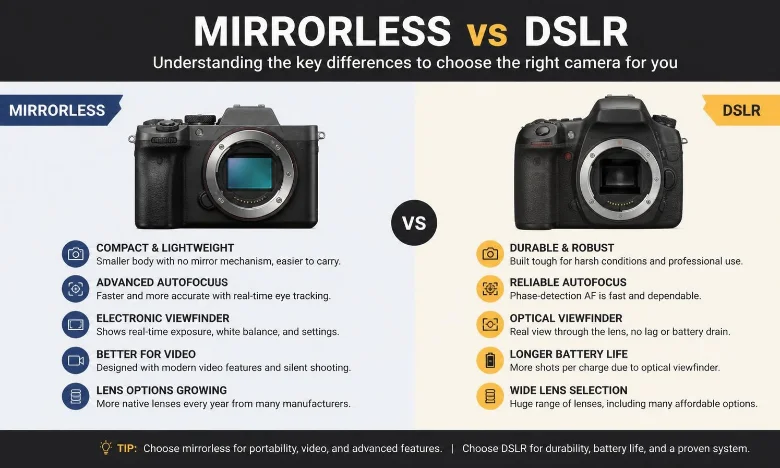
Choosing between a mirrorless and DSLR camera affects far more than body size. Both systems can produce excellent photographs with the right sensor, lens, settings, and photographer. For most U.S. buyers purchasing a new camera today, mirrorless offers newer autofocus, stronger video features, and growing lens systems.
DSLR cameras still make sense for certain photographers. Their optical viewfinders, long battery life, familiar controls, and affordable used equipment remain attractive. Your budget, existing lenses, shooting style, and video needs should guide the final choice.
Mirrorless vs DSLR at a Glance
| Feature | Mirrorless Camera | DSLR Camera |
| Viewfinder | Electronic viewfinder | Optical viewfinder |
| Body design | No mirror mechanism | Uses mirror mechanism |
| Size | Usually smaller | Usually larger |
| Autofocus | Strong subject tracking on newer models | Strong traditional viewfinder AF |
| Video | Usually more advanced | Capable, but fewer modern options |
| Battery life | Generally shorter | Generally longer |
| Lens market | Growing modern systems | Huge established and used selection |
| Exposure preview | Available through EVF | Optical view does not simulate exposure |
| Used value | Varies widely | Often attractive |
| Best fit | New buyers, hybrid creators, travel | Budget stills, existing DSLR owners |
Direct answer: Mirrorless cameras suit most people buying a new interchangeable-lens camera because they offer modern autofocus, strong video features, electronic exposure previews, and expanding lens systems. DSLRs remain useful for photographers who value optical viewfinders, longer battery life, familiar handling, or inexpensive used bodies and lenses.
What Is the Difference Between Mirrorless vs DSLR Cameras?

A DSLR uses a mirror inside the camera body to direct incoming light toward an optical viewfinder. Pressing the shutter moves that mirror so light reaches the image sensor. This design lets you view the actual scene through the lens without relying on an electronic display.
In Mirrorless vs DSLR cameras, a mirrorless design removes the mirror assembly and sends light directly to the image sensor. The camera displays the sensor’s feed on its rear screen or electronic viewfinder. This structure also allows exposure, color, and other settings to appear before you capture the photograph.In Mirrorless vs DSLR cameras, a mirrorless design removes the mirror assembly and sends light directly to the image sensor. The camera displays the sensor’s feed on its rear screen or electronic viewfinder. This structure also allows exposure, color, and other settings to appear before you capture the photograph.
Removing the mirror also changes how manufacturers design camera bodies, autofocus systems, and lenses. It doesn’t automatically guarantee better photographs. Sensor quality, optics, lighting, technique, and processing remain major factors in the final image.
Mirrorless vs DSLR: 9 Differences That Matter
1. Size and Weight
Mirrorless bodies are usually smaller because they don’t require a mirror box or optical viewfinder assembly. That difference can matter during travel, street photography, hiking, or long shooting days. Canon likewise describes its mirrorless options as generally having a smaller footprint than DSLR bodies.
A smaller body doesn’t always mean a dramatically lighter camera bag. Large-aperture full-frame lenses can stay heavy regardless of the body attached. Compare the complete camera-and-lens combination, not body weight alone.
2. Optical vs Electronic Viewfinders
A DSLR optical viewfinder shows the scene directly through the camera’s optical system. It offers a natural view without requiring a digital display. Many longtime photographers still enjoy this immediate shooting experience.
An electronic viewfinder shows an image generated from the sensor’s live feed. It can preview exposure, white balance, and other adjustments before you press the shutter. That feedback can make learning manual exposure easier for new photographers.
Electronic finders also provide digital information directly within your field of view. Yet they consume power and can feel different from an optical finder. Trying both designs in a store can reveal which experience feels more comfortable.
3. Autofocus and Subject Tracking
Modern mirrorless bodies commonly place autofocus capabilities across a large portion of the imaging sensor. This arrangement supports sophisticated tracking for faces, eyes, animals, vehicles, and moving subjects. Sony, for example, highlights wide-frame focus coverage and subject tracking in its current mirrorless range.
DSLR autofocus remains capable, especially on higher-end bodies built for sports and action. Their traditional viewfinder autofocus systems can respond quickly and reliably. The difference is more apparent when comparing older DSLRs with recent cameras that use advanced subject recognition.
This advantage matters most for wildlife, sports, pets, children, and events. Portrait photographers can also benefit from reliable eye detection. Static subjects place much less pressure on either system.
4. Image Quality
Camera type alone doesn’t decide image quality. Both designs offer large sensors and interchangeable lenses that can produce detailed, professional photographs. Canon notes that both systems can deliver strong image quality with full-frame and APS-C sensors.
Sensor generation, resolution, dynamic range, lens quality, and exposure technique matter more than having a mirror. A well-used older DSLR can outperform a poorly configured newer camera. Buying a new body won’t replace sound photography fundamentals.
If photography is your priority, reserve enough money for lenses. Good glass can remain useful across several camera-body upgrades. Techrolab’s coverage of the Xiaomi 17 Pro Max’s camera specifications and imaging technology also shows how much imaging depends on the entire hardware system.
5. Video Capabilities
Video is one area where newer cameras have a clear practical advantage. Current models commonly combine sensor-based autofocus with high-resolution recording, subject tracking, and creator-focused display features. Canon specifically positions its modern mirrorless lineup as well suited to video.
DSLRs can still produce excellent footage. They became important tools for digital filmmaking and online video long before today’s systems matured. Their limitations become more noticeable if you need advanced tracking or newer hybrid photo-video features.
A creator shooting YouTube videos, interviews, travel content, or social clips should examine video specifications carefully. Resolution alone shouldn’t decide the purchase. Autofocus behavior, recording limits, stabilization, overheating, ports, and available lenses can matter more.
6. Battery Life
DSLRs generally hold an advantage in battery endurance during viewfinder photography. Their optical viewfinders don’t need a continuously powered screen to display the scene. This efficiency can be useful during weddings, long events, wildlife trips, or remote travel.
Mirrorless bodies continually rely on electronic components during composition. Their sensor, processor, rear screen, or electronic viewfinder therefore consumes additional power. Carrying a spare battery usually solves the issue for everyday photographers.
Battery performance also varies considerably between individual camera models. Don’t judge a specific purchase only by its camera category. Check the manufacturer’s rated battery performance and independent testing for the model you’re considering.
7. Lens Selection and Compatibility
DSLR systems benefit from decades of lens development. The used market contains many compatible lenses at different prices, which can make an older system attractive. This selection is especially useful for photographers building a capable kit on a limited budget.
Modern lens development increasingly centers on newer mounts. Canon’s RF system, for example, is designed around its current camera architecture. Canon also supports using many older EF lenses on compatible EOS R bodies through mount adapters.
Existing lenses should influence your buying decision. Replacing several quality lenses can cost much more than changing camera bodies. Consider the total system price before switching mounts.
8. Shooting Speed and Silent Photography
Removing a moving mirror gives camera designers more flexibility around high-speed shooting. Many current bodies offer fast electronic burst modes that help with sports, wildlife, and unpredictable action. Some models can also capture images with little or no mechanical shutter noise.
Silent shooting can help during weddings, performances, ceremonies, and wildlife photography. Electronic shutters can have drawbacks under certain lighting or fast-motion conditions. Read the specifications for the specific model rather than assuming every electronic mode behaves the same way.
DSLR burst performance varies widely by model and price tier. Professional bodies were designed specifically for demanding action photography. They remain capable tools even though newer systems provide additional electronic options.
9. Price and Long-Term Value
New camera development now heavily favors newer systems, while DSLR equipment has a mature secondhand market. That creates an interesting buying situation for budget-conscious photographers. A used DSLR body and quality lens can provide excellent still-image capability for relatively little money.
Buying new changes the calculation because future lenses and features increasingly center on current mounts. A beginner planning years of upgrades may prefer starting with a system receiving ongoing development. Someone needing an inexpensive photography setup today may find older equipment more appealing.
Techrolab readers comparing technology purchases can apply the same total-cost approach used in thesite’ss Pixel 6 and Pixel 7 comparison. Purchase price matters, but accessories, compatibility, longevity, and future upgrades matter too.
Pros and Cons of Mirrorless Cameras
Mirrorless systems combine several technologies that simplify difficult shooting situations. Their electronic finders provide useful previews, while newer autofocus systems can reduce the effort required to track moving subjects. These features make them particularly appealing to beginners and hybrid creators.
Pros
- Smaller bodies are available across many price ranges.
- Electronic viewfinders can preview exposure changes.
- Modern subject-detection autofocus can simplify action photography.
- Strong video features suit hybrid creators.
- Current lens development favors newer mounts.
Cons
- Electronic displays consume more battery power.
- Some high-end lenses remain large and expensive.
- Electronic viewfinders don’t feel natural to every photographer.
- Changing systems can make existing equipment harder to reuse.
The strongest case for these cameras is their combination of still photography and video features. Buyers entering an interchangeable-lens system for the first time can build around current technology. They also avoid investing heavily in a mount with fewer new products arriving.
Pros and Cons of DSLR Cameras
DSLRs have decades of refinement behind them. Their controls, optical finders, and mature lens catalogs still satisfy many photographers. The secondhand market can also offer substantial value.
Pros
- Optical viewfinders provide a direct view of the scene.
- Battery life is generally strong when shooting through the viewfinder.
- Used bodies and lenses can be affordable.
- Large established lens catalogs remain available.
- Larger grips can feel comfortable with heavy lenses.
Cons
- Bodies are commonly larger and heavier.
- New product development is limited compared with current systems.
- Older models may lack sophisticated subject detection.
- Video features often trail newer alternatives.
- Future native lens choices may expand more slowly.
A DSLR is especially reasonable when you already own compatible lenses. Selling an entire working kit to gain features you won’t use may provide little practical benefit. Photography results matter more than having the newest body.
Which Camera Type Is Better for Beginners?
Most beginners buying new equipment should start by looking at current mirrorless options. Exposure previews can help explain how shutter speed, aperture, ISO, and white balance affect an image. Modern autofocus also removes several technical obstacles while you’re learning composition and timing.
Budget can change that answer. A clean used DSLR paired with an inexpensive prime or kit lens can teach the same core photography principles. You can put the money saved toward lenses, lighting, travel, or other equipment.
Beginners should also consider how much equipment they want to carry. A smaller setup can encourage you to bring your camera more often. Portability matters only if the lenses you choose keep the full kit manageable.
Which Is Better for Professional Photography?
Professional requirements vary too much for one camera type to fit every photographer. Sports shooters prioritize autofocus, burst performance, and telephoto lenses, while studio photographers may care more about resolution and tethering. Wedding photographers need dependable autofocus, battery management, dual-card options, and reliable low-light performance.
Current high-end systems provide sophisticated autofocus and hybrid features that suit demanding professional work. Still, existing professional DSLR equipment can still produce strong images. Replacing working equipment makes the most sense when newer features solve a specific problem.
Consider your complete workflow before upgrading. Storage, computers, accessories, lenses, batteries, and editing software can all affect the real cost. Techrolab’s guide to wireless camera features and setup considerations offers another example of why you should consider specifications alongside practical use.
Mirrorless or DSLR for Travel, Wildlife, and Video?
For travel, compact bodies and smaller lens combinations can reduce the weight you carry all day. Electronic exposure previews also help when lighting changes quickly between locations. Battery planning becomes more important during long trips away from power.
For wildlife and sports, modern subject tracking and wide autofocus coverage can make moving subjects easier to follow. DSLRs remain capable when paired with strong autofocus systems and suitable telephoto lenses. Existing owners with expensive long lenses may have little reason to switch immediately.
Video creators will usually find more current features in newer systems. Sensor-based autofocus, flexible displays, and hybrid controls can simplify solo production. Before buying, check each model’s recording modes, heat management, stabilization, microphone support, and crop behavior.
The Verdict: Which Should You Choose?
For most U.S. shoppers buying a new interchangeable-lens camera, mirrorless is the more practical starting point. Current systems receive more attention in autofocus, video, and lens development. They also offer useful electronic previews that can help both beginners and experienced photographers.
A DSLR can still be the sensible purchase when value matters more than having newer features. Used bodies and lenses can build an impressive photography kit at an accessible price. Existing owners should upgrade because they need a specific capability, not because their current camera suddenly became obsolete.
Before purchasing, choose your lens system first, then your camera body. List the lenses you expect to need during the next few years. Then compare total system cost, handling, autofocus, video features, and battery requirements.
Final Buying Checklist
Before spending money, compare the complete system, not just one specification. A camera body is only one part of a long-term photography setup. Your lenses, batteries, accessories, and future upgrades can end up costing more than the original body.
- Decide whether photography, video, or hybrid shooting matters most.
- Compare the lenses you expect to buy.
- Check autofocus features for the subjects you photograph.
- Handle both viewfinder types before choosing.
- Calculate body, lens, battery, and accessory costs.
- Consider used equipment if your budget is limited.
- Choose a system you can carry and use comfortably.
The right camera removes obstacles between you and the photographs or videos you want to create. New buyers will often find current systems easier to grow with, while bargain hunters can still find excellent value in older DSLR equipment. Base the purchase on your actual shooting needs rather than the age of the technology.
Frequently Asked Questions
What is the main difference between mirrorless and DSLR cameras?
A DSLR directs light through a mirror system toward an optical viewfinder. A camera without that mirror uses its imaging sensor to generate an electronic preview. This structural difference affects body design, viewfinder behavior, autofocus implementation, and battery use.
Do mirrorless cameras take better pictures than DSLRs?
Not automatically. Both camera types can produce excellent photographs with good sensors and lenses. Lighting, composition, exposure, optics, and photographer skill often have a larger effect on the final result.
Are DSLR cameras obsolete?
No, existing DSLR equipment can still produce professional-quality photos. The key change is that much current camera and lens development has shifted toward newer systems. That matters most to buyers building a system they plan to expand for years.
Are mirrorless cameras better for beginners?
They can be easier for many beginners because an electronic viewfinder can preview exposure and other settings. Modern subject tracking can also rmakeit easier to ffocus onpeople or moving subjects. A lower-priced used DSLR remains a practical learning tool.
Should I replace my DSLR with a mirrorless camera?
Replace it when a newer system solves a problem your current equipment cannot handle well. Better subject tracking, video capabilities, smaller equipment, or access to newer lenses can justify switching. Keeping a reliable DSLR can make more financial sense when it already meets your needs.
Can DSLR lenses work on newer camera bodies?
Many older lenses can work on compatible newer bodies through manufacturer-supported adapters. Features and compatibility depend on the specific lens, adapter, and camera combination. Check official compatibility information before assuming every lens function will transfer.