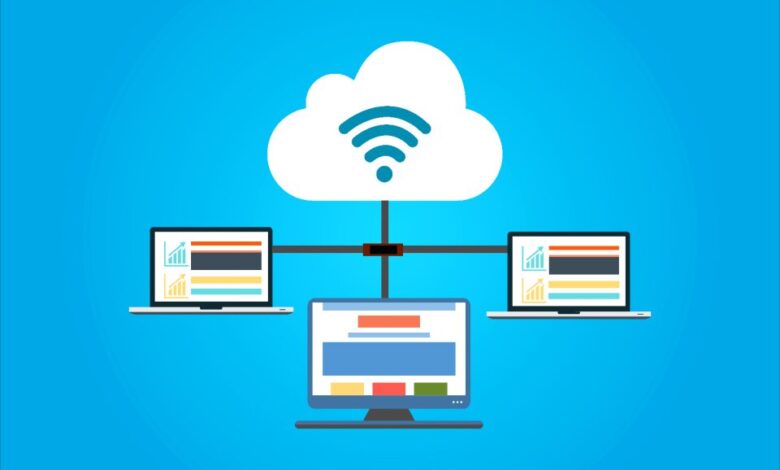
In today’s digital age, businesses and individuals are increasingly relying on cloud computing to streamline operations. It enhances efficiency and reduces costs. From storing data to running applications, cloud computing has become integral to modern technology infrastructure. In this article, we’ll delve into cloud computing, exploring its types, benefits, challenges, and future trends. Some important features of cloudy computing are below:
| Feature | Description |
|---|---|
| On-Demand Self-Service | Users can provision computing capabilities, such as server time and network storage, as needed without requiring human interaction with the cloud service provider. |
| Broad Network Access | Computing capabilities are available over the network and can be accessed through standard mechanisms that promote use by heterogeneous thin or thick client platforms (e.g., mobile phones, tablets, laptops, and workstations). |
| Resource Pooling | The provider’s computing resources are pooled to serve multiple consumers using a multi-tenant model, with different physical and virtual resources dynamically assigned and reassigned according to consumer demand. |
| Rapid Elasticity | Capabilities can be elastically provisioned and released, in some cases automatically, to scale rapidly outward and inward commensurate with demand. To the consumer, the capabilities available for provisioning often appear to be unlimited and can be appropriated in any quantity at any time. |
| Measured Service | Cloud systems automatically control and optimize resource use by leveraging a metering capability at some level of abstraction appropriate to the type of service (e.g., storage, processing, bandwidth, and active user accounts). Resource usage can be monitored, controlled, and reported, providing transparency for both the provider and consumer of the utilized service. |
| Multitenancy | Multiple customers are served from the same physical infrastructure, with logical separation between customer data and applications. |
Introduction
Cloud computing refers to the delivery of computing services over the Internet. It provides users access to a pool of resources such as storage, servers, databases, networking, and software on a pay-as-you-go basis. This shift from traditional on-premises infrastructure to cloud-based solutions. It has revolutionized how businesses operate, allowing for greater agility and scalability.
The concept of cloud computing has evolved over the years, from computing to the advent of virtualization and distributed computing, with the proliferation of high-speed internet and advancements in virtualization technology. Cloud computing has become more accessible and affordable for organizations of all sizes.
Types of Cloud Computing
Cloud computing can be categorized into several deployment models, each offering unique advantages and use cases.
Public Cloud
Public clouds are owned and operated by third-party service providers, resources to the general public over the Internet. Examples include Amazon Web Services (AWS), Microsoft Azure, and Google Cloud Platform. Public clouds are ideal for organizations looking to scale rapidly without upfront investment in infrastructure.
Private Cloud
Private clouds, on the other hand, are dedicated to a single organization, either hosted on-premises or by a third-party provider. Private clouds offer greater control, security, and customization options. It makes them suitable for industries with strict regulatory requirements such as healthcare and finance.
Hybrid Cloud
Hybrid clouds combine the benefits of public and private clouds, allowing organizations to leverage the scalability of the public. This hybrid approach offers flexibility and cost savings, enabling seamless workload migration and resource optimization.
Community Cloud
Community clouds share infrastructure environments catering to specific industries or interest groups, such as government agencies, research institutions, or educational organizations. The community enables collaboration by pooling resources and sharing costs while ensuring compliance with industry standards and regulations.
Benefits
Cloud computing offers numerous benefits to businesses and individuals alike, including:
Cost Efficiency
By eliminating the need for upfront capital investment in hardware and software. Cloud computing allows organizations to pay only for the resources they consume, resulting in cost savings.
Scalability
Cloud computing platforms are highly scalable, enabling organizations to quickly and easily scale resources up or down based on demand. This scalability ensures optimal performance and resource utilization.
Flexibility
It offers unparalleled flexibility, from anywhere with an internet connection. This flexibility enables remote work, collaboration, and disaster recovery planning, ensuring business continuity in the face of unforeseen events.
Read More: Internet of Things: Transforming The World With Connected Devices
Accessibility
With cloud computing, data, and applications are accessible from any device with an internet connection. It enables seamless collaboration and productivity across geographically dispersed teams. This accessibility fosters innovation and agility, driving business growth and competitiveness.
How Cloud Computing Transforms Modern IT Infrastructure
Cloud computing has fundamentally changed the way organizations build and manage IT infrastructure by enabling on-demand access to shared computing resources over the internet. Instead of investing heavily in physical servers, storage systems, and network equipment, businesses can now tap into scalable virtual servers, storage, databases, and software services provided by cloud platforms.
This model allows companies to quickly adjust capacity based on real needs, reduce upfront hardware costs, and shift from capital expenditures to predictable operating expenses. Additionally, cloud computing supports greater collaboration and remote work, as users can access applications and data from virtually anywhere on any device.
By abstracting the underlying hardware and centralizing management, cloud computing not only simplifies deployment but also accelerates innovation across industries ranging from healthcare to finance and education, making it a cornerstone of digital transformation strategies.
Common Cloud Computing Services
Cloud services can be divide into three main types:
Infrastructure as a Service (IaaS)
IaaS provides virtualized computing resources over the internet, including virtual machines, storage, and networking infrastructure. Users can deploy and manage virtualized servers and storage without the need for physical hardware, reducing costs and complexity.
Platform as a Service (PaaS)
PaaS offers a platform for developers to build, deploy, and manage applications without the need to manage underlying infrastructure. PaaS providers offer tools and services such as development frameworks and databases.
Software as a Service (SaaS)
SaaS delivers software applications over the internet on a subscription basis. It eliminates the need for users to install, maintain, and update software locally. Examples of SaaS applications include email, customer relationship management (CRM), and features without the hassle of traditional software deployment.
Conclusion
In conclusion, cloud computing has transformed the way we store, manage, and access data and applications. It offers unparalleled flexibility, scalability, and cost efficiency for organizations of all sizes and industries. As technology continues to evolve, it will continue to drive innovation, and accelerate digital transformation.
Apart from that if you want to know about Why You Should Build then please visit our Software page.
FAQs
Cloud computing refers to the delivery of computing services over the Internet. It provides users with access to a pool of resources such as storage, servers, and databases.
It offers numerous benefits, including cost efficiency, scalability, and flexibility to compete more effectively in the digital economy.
Security concerns in cloud include data privacy, compliance issues, and cybersecurity threats such as malware, and ransomware.
Emerging trends in cloud include serverless computing, edge computing, and multi-cloud strategy.
Examples include online data storage, email services, virtual servers, software applications, and backup solutions accessed through the internet.